Remote Field Eddy Current Testing (RFET)

RFET (or RFT as it is commonly known) has been used to inspect diameters up to 72 inches and wall thicknesses up to 1.5 inch (not at the same time). The limitation on diameter and wall thickness is really imposed by the design of the instrument and probe carrier, not by the physics of RFT itself. For heavy wall such as cast iron pipe, frequencies around 20 Hz would be needed. And since this frequency is in the domain of probe vibration, a smooth ride is essential and the probe must be pulled very slowly. Larger diameter pipes will need multiple receiver coils for sensitivity to local defects.
For fin fan, use "near field" probes. The fins do not allow the field from the remote field probes to travel on the outside of the tube, so the signal is lost.
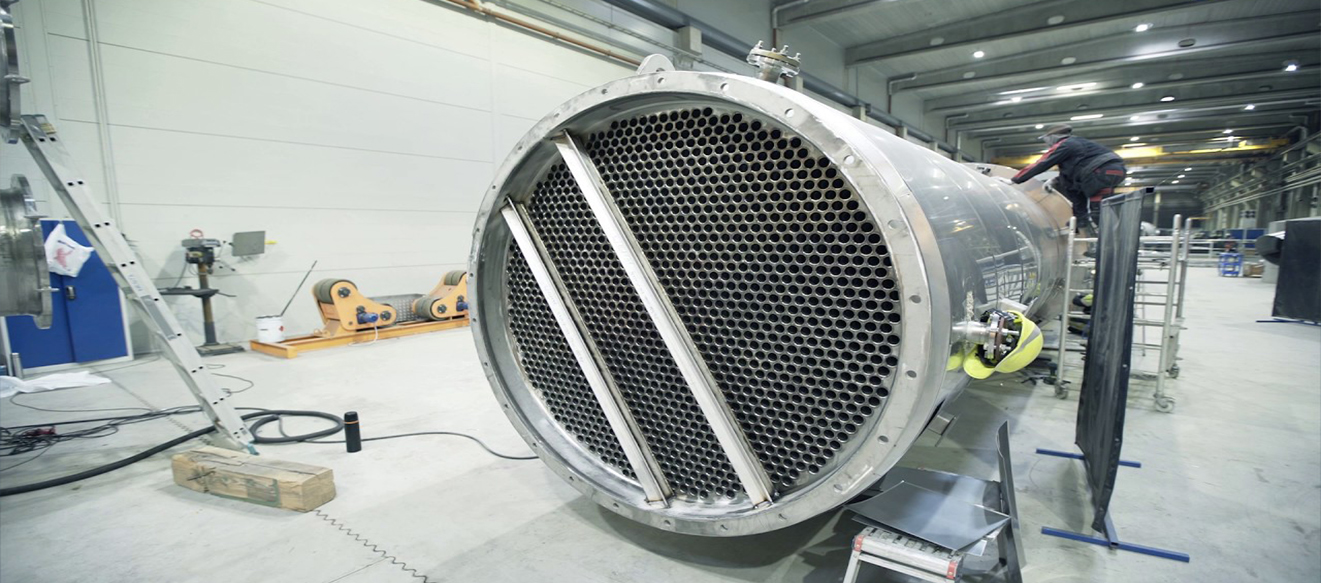
For heat exchanger tubes, clean the tubes to remove debris that may impede the passage of the probe or cause probe vibration, especially if the debris is magnetic.
Advantages
1. Can inspect ferromagnetic tubes up to 3.5 inches in diameter with 0.125 inches wall thickness.
2. Inspection speed (up to approx. 40 feet per minute).
3. Can detect large-area discontinuities such as steam erosion and baffle wear.
4. Amplitude changes in the signals sensed are not speed-sensitive.
5. Flexible probes can be used to inspect and travel through U-bend areas.
6. Permanent records can be obtained on test results.
Limitations
1. Some limitation to distinguishing ID from OD defects.
2. Evaluation of small flaws such as pits can be difficult.
3. Impingement erosion and wall loss detectability is limited to approximately 20% and greater.
4. Requires high inspection skills for data analysis and evaluation.
5. Instrumentation and test probes can be very expensive.
6. Tubes must be cleaned.
7. Inaccuracy in test results could occur if a discontinuity encountered differs in geometry from calibration discontinuities.
Programme Highlights
Hands-on Practical Training
Real equipment and live specimens, not just theory in a classroom.
Certification Guidance
Structured prep towards recognized NDT certification standards.
Experienced Instructors
Sessions led by working NDT professionals from the field.
Small Batch Sizes
Focused, individual attention instead of large lecture halls.
Who This Course Is For
Freshers & Engineering Graduates
A structured entry point into an NDT/inspection career.
Working Technicians
Upgrade or renew certification alongside current field work.
Industry & QA Teams
Build in-house inspection capability for your organization.
No upcoming batches scheduled yet for this course — contact us and we'll notify you as soon as new dates open.
Sample reviews shown for illustration — real trainee testimonials will replace these once collected.
"The hands-on sessions made all the difference — I felt genuinely prepared going into my certification exam."
"Small batch size meant the trainer could actually walk around and correct technique in real time."
"Good balance of theory and practical time. Would recommend to colleagues starting out in NDT."